10 Set a 11 Dez 2026
INAUGURAÇÃO | “Sobre os Sonhos – Grund”
“Sobre os Sonhos – Grund”, de Manuel Valente Alves, inaugura no próximo dia 10 de setembro, no Centro Cultural do ISPA – Instituto Universitário, em Lisboa. A...

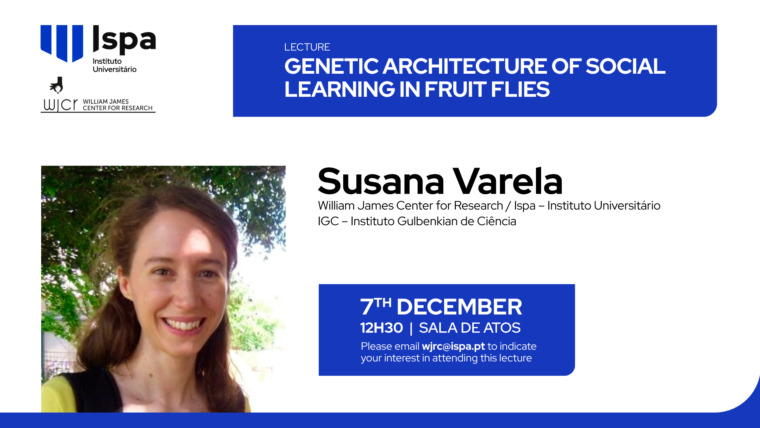
No próximo dia 7 de dezembro às 12h30 na Sala de Atos do Ispa, a investigadora Susana Varela (WJCR / Ispa – Instituto Universitário; IGC – Instituto Gulbenkian de Ciência) vai dar uma palestra com o título Genetic Architecture of Social Learning in Fruit Flies.
Inscrições por e-mail: wjrc@ispa.pt
Note: Please email wjrc@ispa.pt to indicate your interest in attending this lecture.
Abstract:
Social learning occurs when animals observe the behaviour of others and learn indirectly from their experiences. Along with asocial learning, it is required to cope with the complexity of the environment. However, whether it depends on a special-purpose cognitive mechanism or a general-purpose mechanism shared with asocial learning remains unknown. Our aim is to address this question by studying the genetic architecture of social learning in Drosophila melanogaster and verifying whether it is distinguished from the genetic architecture of asocial learning.
We first tested social and asocial learning abilities in 40 lines of a Drosophila genetic reference panel constituted of isogenic homozygous sequenced lines that together represent the genetic variation of a natural Drosophila population. We used aversive conditioning paradigms for oviposition sites. We obtained significant learning performance variation across the tested lines that showed no correlation between social and asocial learning.
Secondly, we tested the correlation between the learning performance of each line and their genes, using the information about their sequenced genomes. We obtained two different sets of candidate genes for social and asocial learning, ranging from genes with unknown biological activity to genes already known to be related to learning.
Thirdly, for the six genes most associated with each of the learning phenotypes, we analysed their expression patterns in the Drosophila brain and found that some are expressed in the mushroom body (MB), the associative learning centre in insects. To functionally validate the role of these MB-expressed genes on each learning phenotype, we used a technique to silence their activity, one at a time. If the flies with the silenced genes change their learning performance compared with control flies, this will be evidence of their causal role in controlling learning ability.
We are still running the functional validation experiments. However, so far, we have found genes specialized for social learning, as well as trade-off and general-purpose genes. Together, these results suggest a mixed mechanism of cognition, including a domain-specific genetic architecture for social learning in Drosophila.
10 Set a 11 Dez 2026
“Sobre os Sonhos – Grund”, de Manuel Valente Alves, inaugura no próximo dia 10 de setembro, no Centro Cultural do ISPA – Instituto Universitário, em Lisboa. A...
24 Set 2026
Resumo Partindo dos principais modelos teóricos e da investigação empírica em Psicologia da Arte, esta conferência apresenta uma proposta integradora para compreender os processos psicológicos envolvidos na...
08 Out 2026
Resumo As doenças crónicas constituem um dos principais desafios de saúde pública, dada a sua elevada prevalência e o impacto significativo que podem ter na qualidade de...
12 Out 2026
Resumo: Speciation is one of the most fundamental processes in evolution. In livebearing fishes (Poeciliidae), alongside allopatric and sympatric speciation, instant speciation can also be observed. This...